If you spend even ten minutes browsing eCommerce forums, you’ll encounter the exact same heartbreaking complaint posted every single day:
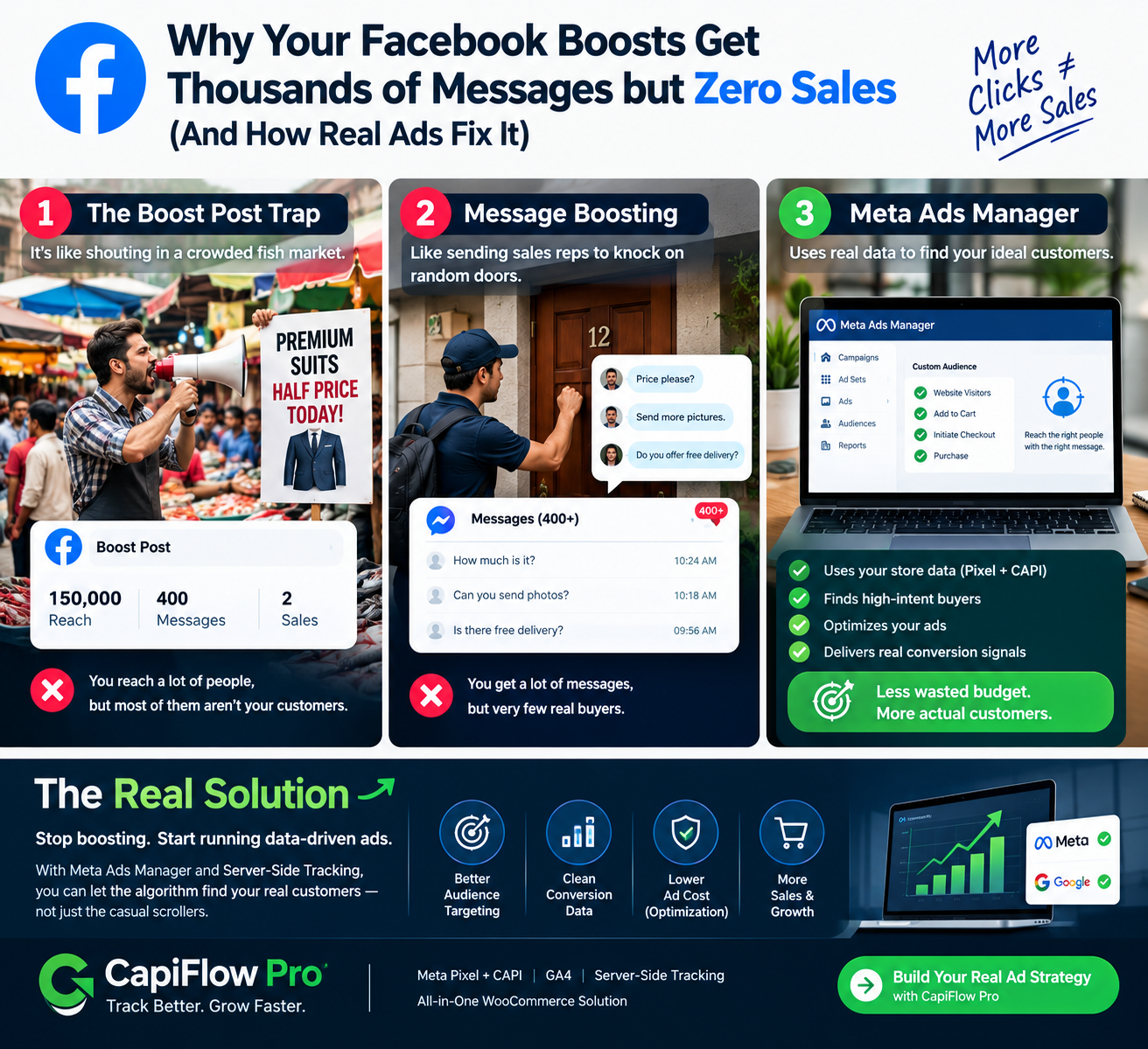
“I spent $50 boosting a post. Got 150,000 reach, 400 inbox messages, and… exactly two sales. Is Meta just burning my money?”
Here is the brutal truth: Meta didn’t steal your money. Your strategy failed because you confused Boosting a Post with running a Data-Driven Ad Campaign.
To the untrained eye, both look like paid marketing on Facebook. Under the hood, they operate in completely different universes.
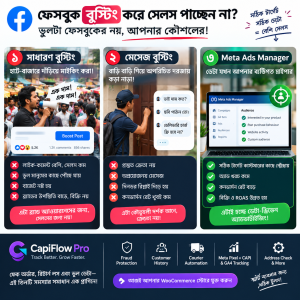
1. The “Boost Post” Trap: Shouting Through a Megaphone in a Crowded Fish Market
Imagine packing a suitcase full of tailored luxury suits. Instead of visiting business hubs or corporate offices, you march straight into a chaotic, crowded Sunday fish market.
You pull out a battery-powered loudspeaker and start screaming at the top of your lungs: “Finest suits! Half price today! Come grab yours!”
People will stare. A crowd will gather. Kids might point and laugh. At the end of the day, you reached 10,000 people. But did you sell any suits? Of course not. People came to buy groceries, not three-piece suits.
Clicking the blue “Boost Post” button on Facebook is the digital equivalent of that megaphone. It instructs Meta’s algorithm to chase one metric: Surface Engagement. Meta finds the cheapest available screen real estate—delivering your post to habitual scrollers who double-tap every meme and leave random comments. They look at your post, but they have zero intention of opening their wallets.
2. Message Boosting: Sending Sales Reps to Knock on Every Random Door
Some store owners push back: “I don’t boost for likes; I boost for messages!”
Let’s translate that into the real world. That’s like hiring five sales reps and instructing them to walk down a random street, knocking on every single apartment door: “Hello, would you like to hear about our organic skincare oil?”
The salesperson doesn’t know who lives behind that door. They don’t know the homeowner’s age, their skin type, their income, or if they even use skincare products.
What happens? A few polite residents will open the door, ask two questions, ask for a free sample, and close the door in your face.
That is why your page inbox is drowning in:
- “Price please?”
- “Send more pictures.”
- “Do you offer free delivery?”
Your support team burns hours answering repetitive queries from window shoppers who were never qualified buyers to begin with.
3. The Meta Ads Manager Advantage: Laser-Guided Precision Engineered by Conversion Data
Meta isn’t stupid. In fact, its machine-learning engine is arguably the most sophisticated behavioral predictor on Earth.
Meta knows:
- Who browses passively versus who buys actively online.
- Who routinely enters credit card details or orders cash-on-delivery.
- Which users abandoned a cart yesterday and are waiting for a subtle reminder today.
However, Meta will not hand you its top-tier buyers for free. You must train the algorithm with your own store data.
When you operate through the Meta Ads Manager and equip your store with Server-Side Tracking (Conversions API):
- You inform Meta exactly what products are generating interest.
- You feed Meta the exact profiles of visitors who initiated checkout versus those who bounced.
- You signal when an actual purchase happens—and crucially, when an order is cancelled or fraudulent.
With that feedback loop in place, Meta stops roaming randomly through street markets. It bypasses the casual scrollers and places your product directly in front of high-intent buyers who are currently in the market for what you sell.
The Takeaway
Facebook never engineered the “Boost” button to scale profitable businesses. It was built as a lightweight, low-friction tool for quick social awareness.
If you are running an e-commerce business, stop relying on digital megaphones. Shift to Meta Ads Manager, implement robust server-side conversion tracking, and let algorithmic machine learning find your true customers.